There's something different about working in community development.
Your work doesn't necessarily end when you leave the office.
The people you serve are often your neighbors. The organizations you support are part of your community. The projects you're working on can influence whether businesses grow, families find opportunities and communities become stronger places to live.
The work matters.
And for the people who choose careers in community and economic development, that sense of purpose is often what brought them into the field in the first place.
But there's another side to caring so deeply about your work.
The same commitment that makes someone an exceptional community leader can also make them especially vulnerable to burnout.
And it's a challenge that deserves more attention.
When Your Work Feels Personal, It's Hard to Turn It Off
Community and economic development naturally attract people who care.
People who want to make a difference.
People who feel responsible for helping their communities succeed.
People who understand that behind every strategic plan, grant application, business expansion or community initiative are real people whose lives may be affected.
That sense of responsibility can be a tremendous strength.
But it can also make setting boundaries difficult.
There's always another email to answer.
Another funding deadline approaching.
Another community meeting.
Another organization that needs support.
And when the work feels important, stepping away can feel like letting someone down.
The problem isn't that community leaders care too much. It's that caring deeply can make it difficult to recognize when the workload has become unsustainable.
Burnout Doesn't Always Look Like Someone Falling Apart
One of the challenges with burnout is that it isn't always obvious.
Sometimes the person closest to burnout is still showing up.
Still meeting deadlines.
Still supporting colleagues.
Still volunteering to help.
Still telling everyone they're fine.
Meanwhile, they've been operating with very little capacity left for months.
In mission-driven work, admitting you're overwhelmed can feel especially difficult.
You know your colleagues are busy, too.
You know your organization has limited resources.
You know the community is counting on the work getting done.
So you keep going.
But continuing to meet expectations doesn't necessarily mean someone is doing well.
A person can be highly committed to the mission and still be struggling under the weight of the work.
That's why recognizing burnout requires more than waiting for someone to tell you they're overwhelmed.
Leaders Need to Ask Better Questions
If you lead a team, think about the conversations you typically have with your employees.
How is the project going?
Are we on schedule?
What still needs to be completed?
Do you have everything you need?
Those are important operational questions.
But they don't necessarily tell you how someone is doing.
Renee challenges leaders to make room for a different kind of conversation.
Not simply:
"How's the project going?"
But:
"How are you doing, genuinely?"
And then comes the important part.
Listening long enough for the honest answer.
Sometimes people need a moment before they're comfortable sharing what's really happening.
Sometimes they need to know the conversation isn't simply a formality.
And sometimes they need reassurance that acknowledging a challenge won't be interpreted as a lack of commitment.
Creating space for those conversations is an important part of leadership.
But it can't be the only part.
Care Becomes Real When It Changes the Workload
Here's where Renee's message goes beyond simply encouraging leaders to check in with their teams.
Imagine asking an employee how they're doing.
They admit they're overwhelmed.
They explain that several projects are competing for their attention and they're struggling to keep up.
You thank them for being honest.
You tell them they're appreciated.
You encourage them to take care of themselves.
And then?
Nothing changes.
The same deadlines remain.
The same responsibilities stay on their plate.
The same expectations continue.
The conversation may have been well-intentioned, but it hasn't addressed the source of the problem.
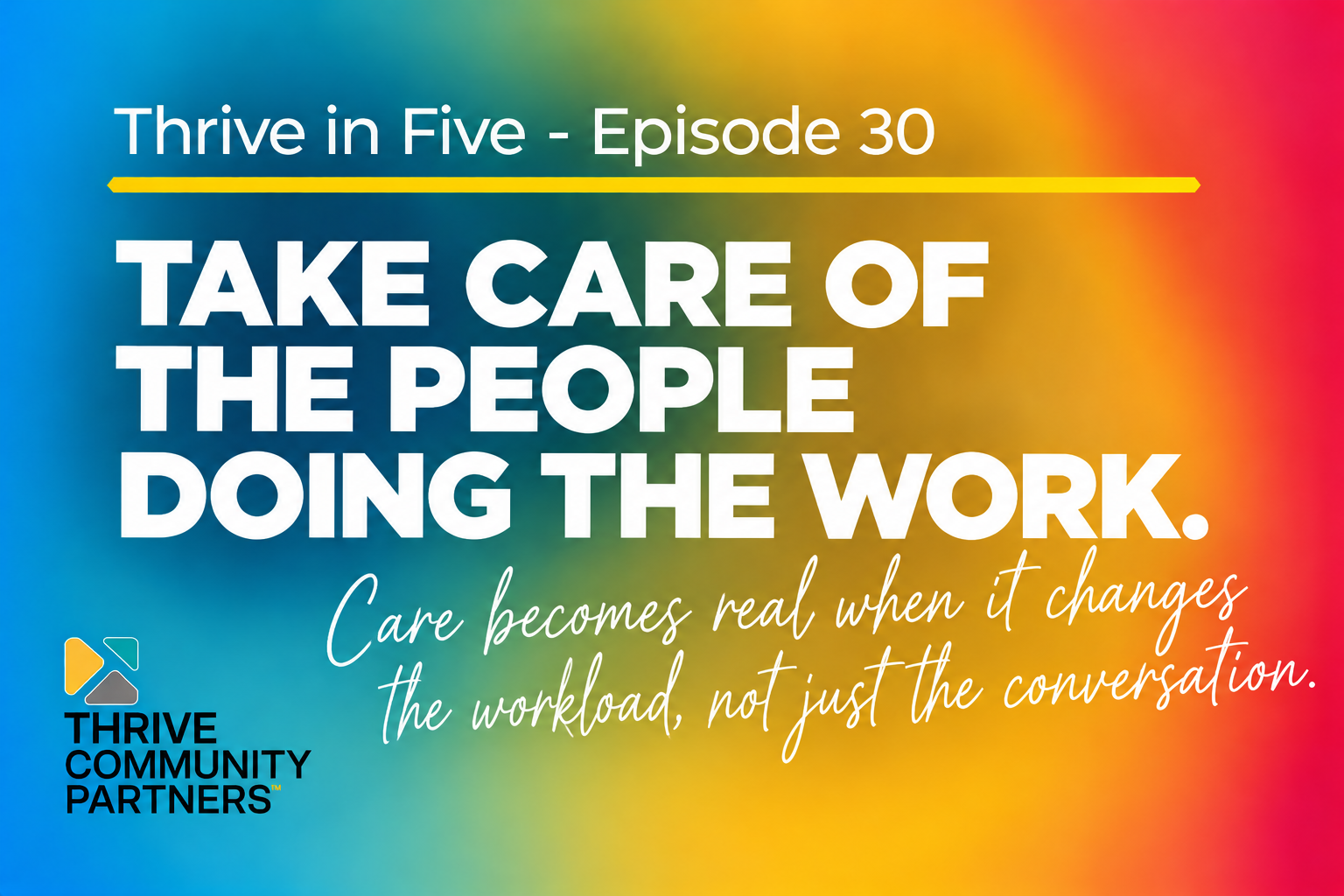
Care becomes real when it changes the workload, not just the conversation.
That's why Renee suggests a more practical follow-up question:
"What can come off your plate this week?"
It's a simple question with meaningful implications.
It acknowledges that the problem may not be the employee's ability to manage stress.
It may be the amount of work they're being asked to carry.
And it opens the door to making an actual adjustment.
Supporting Your Team May Require Changing Expectations
Community organizations frequently operate with limited resources.
Small teams manage significant responsibilities.
Staff members wear multiple hats.
And the needs of the community don't necessarily decrease when organizational capacity is stretched.
That reality makes workload conversations especially important.
If someone is approaching burnout, leaders may need to consider what can realistically change.
Can a deadline move?
Can a responsibility be reassigned?
Can a project be paused?
Can the scope of an initiative be reduced?
Is there work the organization needs to stop doing altogether?
Not every responsibility can be removed immediately.
And not every organization has additional staff or funding available.
But acknowledging those limitations doesn't mean the only option is asking people to keep pushing.
Sometimes protecting organizational capacity requires making difficult decisions about priorities.
If everything is urgent, leaders have a responsibility to determine what truly needs attention first.
The Mission Needs People Who Can Sustain the Work
In community development, there's often an emphasis on building sustainable organizations, programs and funding models.
We talk about long-term planning.
Organizational capacity.
Strategic priorities.
Financial sustainability.
But what about the people responsible for carrying out those plans?
A strategy isn't sustainable if it consistently depends on employees working beyond their capacity.
A program isn't sustainable if its success requires staff members to sacrifice their well-being.
And a community initiative isn't positioned for long-term success if the people leading it are continually exhausted.
Taking care of the people doing the work is part of taking care of the work itself.
That doesn't mean community leaders should care less.
It means organizations need to recognize that commitment is not an unlimited resource.
If You're the One Struggling, Start the Conversation
Not everyone experiencing burnout is in a leadership position.
Sometimes you're the person trying to keep everything moving.
You care about your organization.
You believe in the mission.
You don't want to disappoint your colleagues or the community.
And you're not sure how to explain that the workload has become too much.
Renee offers an important reminder:
You're not the first person in this field to feel this way.
And acknowledging that you're struggling doesn't diminish your commitment to the work.
It may be the most productive step you can take.
Consider starting a conversation with your supervisor, a colleague or a trusted professional peer.
Be specific about what's becoming difficult to manage.
Identify the responsibilities that are creating the greatest strain.
And when possible, discuss what adjustments could help make the workload more sustainable.
You don't need to wait until you've reached a breaking point to ask for support.
Stronger Communities Need Healthy Organizations
Community development is fundamentally about people.
The people who live in a community.
The people who operate its businesses.
The people who lead its organizations.
And the people working behind the scenes to create opportunities and solve problems.
Those professionals deserve the same thoughtful attention we give to the communities they're working to strengthen.
Because when experienced, committed people burn out, organizations lose more than productivity.
They risk losing relationships, institutional knowledge, momentum and the very people who make community progress possible.
Preventing burnout isn't simply a matter of encouraging better personal habits.
It's about creating organizational conditions where people can continue doing meaningful work without being expected to carry more than is sustainable.
Take Care of the People Doing the Work
If you're leading a team, make time for a conversation that goes beyond project updates.
Ask how people are doing.
Listen to the answer.
And be willing to reconsider what's on their plates.
If you're the person struggling, remember that asking for support isn't a failure of commitment.
It's an investment in your ability to continue contributing to the work that matters to you.
The goal isn't to care less about your community. It's to make sure the people who care can keep showing up for years to come.
Because stronger communities need strong organizations.
And strong organizations need people who have the capacity to sustain the work.
Take care of the people doing the work.
Building Organizational Capacity That Lasts?
At Thrive Community Partners, we understand the challenges of balancing ambitious community goals with the resources and capacity available to accomplish them.
We've sat in the seats of the leaders, professionals and organizations doing this work.
Through strategic planning, organizational development and implementation support, we help communities and organizations establish realistic priorities and build the capacity needed to move forward.
If your organization is trying to do more than its current resources can sustain, let's talk about what needs to change.
I'm Renee with Thrive Community Partners. This article is based on an episode of Thrive in Five, where we share practical ideas for moving organizations and communities forward in five minutes or less.