Not All Growth Is Good Growth
There is a message entrepreneurs and organizational leaders hear constantly:
Grow.
Get bigger. Add another service. Reach more people. Increase revenue. Expand your impact. Take the opportunity.
Growth is usually treated as evidence that things are going well.
But I think we need to say something that does not get said often enough:
Not all growth is good growth.
I have watched businesses and organizations grow faster than their people, systems, and resources could support. From the outside, that growth looked like success.
Inside, it felt very different.
People were exhausted. Processes that worked at a smaller scale started breaking. Leaders spent their time putting out fires. And opportunities that once felt exciting became another thing the organization had to somehow sustain.
Growth is not automatically the goal.
Healthy, sustainable growth is.
How Do You Know If Your Business Is Growing Too Fast?
One of the challenges with growth is that the warning signs can look a lot like success.
You have more customers.
More projects.
More revenue.
More opportunities.
More demand.
But more also requires more capacity.
Can your current team handle the additional work?
Do your systems still work at this volume?
Is the new revenue actually producing greater profitability, or are your expenses growing just as quickly?
Are you maintaining the quality that made people choose you in the first place?
And perhaps most importantly:
Is this growth moving you toward the business or organization you actually want to build?
If the answer to those questions is no, getting bigger may not be making you stronger.
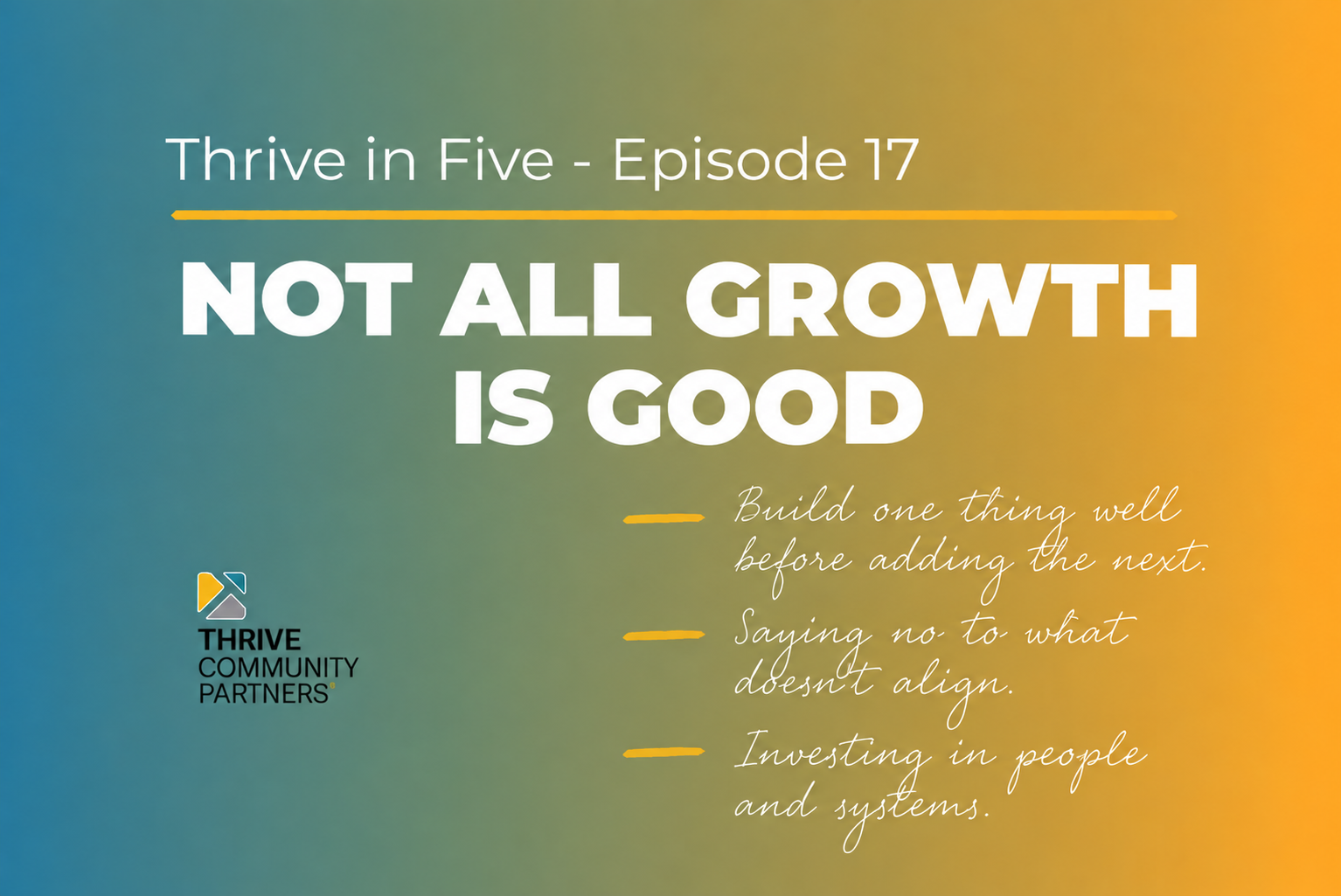
Build One Thing Well Before Adding the Next
New opportunities are exciting.
A customer asks for a service you do not currently offer.
A new market opens up.
A partnership creates the possibility of expanding.
You realize you could add another program, product, or location.
Sometimes the answer absolutely should be yes.
But before adding the next thing, ask whether the thing you already built is working well.
Is it profitable?
Is the process repeatable?
Can someone besides you execute it?
Do you understand what makes it successful?
Have you built the systems needed to support it consistently?
Expansion does not fix a shaky foundation. It puts more weight on it.
There is tremendous value in building one thing really well before deciding what comes next.
Say No to Growth That Does Not Fit
Not every opportunity deserves a yes simply because it could generate revenue or increase your reach.
Some growth pulls you away from your core work.
A new service might require expertise your team does not have.
A large client might generate significant revenue but consume so much capacity that your existing customers suffer.
A new program might sound exciting but have very little connection to your organization's mission.
Growth creates momentum, but it can also create distraction.
That is why sustainable growth requires knowing what you are building toward.
When an opportunity appears, ask:
Does this help us become more of what we are trying to be?
If it does not, saying no may be the better growth strategy.
Invest Before You Need It
This is one of the hardest parts of sustainable growth.
We tend to invest in capacity when we have already run out of it.
We hire after everyone is overwhelmed.
We build the system after the old process has broken.
We seek financial help when cash flow has become a crisis.
We document the process after the person who knew how to do it has left.
By then, every decision feels urgent.
Whenever possible, build ahead.
What systems will you need if demand increases?
Where is your team already stretched?
What expertise will you need at the next stage?
What financial resources should be in place before you expand?
The best time to build capacity is before you are desperate for it.
Know Your Numbers and Your Limits
Intentional growth requires knowing what the business can actually support.
That means understanding your numbers.
What does it cost to deliver your product or service?
Which work is actually profitable?
How much capacity does your team have?
At what point would another client, program, or project require another person?
What resources would expansion require before it begins producing a return?
But it also means understanding limits that do not show up neatly on a spreadsheet.
Your team's energy matters.
Quality matters.
Leadership capacity matters.
Your ability to serve existing customers well matters.
There is nothing strategic about growing revenue while quietly breaking everything that made the organization successful.
Sustainable Growth Is Not Settling
I think this is where leaders sometimes struggle.
Choosing to grow more slowly can feel like a lack of ambition.
It is not.
There is a difference between being afraid to grow and being intentional about growth.
One says, We should stay where we are because change feels risky.
The other says, We know where we want to go, and we are going to build the people, systems, and resources necessary to get there.
That is not thinking small.
That is building something capable of lasting.
So before you automatically say yes to the next opportunity, ask a few questions.
Are we ready for this?
Does it align with where we are going?
What will it require from our people and systems?
What needs to be built before we take it on?
And if the answer is not yet, that does not mean never.
It may simply mean you are choosing to build the foundation first.
Not all growth is good growth. The goal is not simply to get bigger. It is to build something strong enough to grow well.
I'm Sarah with Thrive Community Partners. This article is based on an episode of Thrive in Five, where we share practical ideas for moving organizations and communities forward in five minutes or less.