Imagine your community has done everything right to attract a new employer.
You've invested in infrastructure, built relationships with business leaders, identified available properties and demonstrated that your community is ready for growth.
The employer is interested. The jobs are coming. The opportunity feels real.
But there's one question that could determine whether the investment actually happens.
Where will the employees live?
It's a question that doesn't always receive the same attention as tax incentives, available sites or workforce training programs.
And yet, it may be just as important.
At Thrive Community Partners, we see a recurring challenge in communities working to strengthen their local economies: housing and economic development are often treated as separate conversations.
One group focuses on attracting employers, retaining businesses and growing the tax base.
Another focuses on affordable housing, residential development and the availability of rental properties.
Both conversations are important.
But they shouldn't be happening independently of one another.
The Connection Between Housing and Economic Development
Economic development strategies are often built around a familiar set of priorities.
Business attraction.
Business retention and expansion.
Workforce development.
Infrastructure investment.
Entrepreneurship and small business support.
These efforts help communities create opportunities for economic growth.
But attracting jobs is only part of the equation.
Communities also need people who can fill those jobs, remain in those positions and participate in the local economy.
And those people need somewhere to live.
If workers cannot find housing that fits their incomes, household needs or commuting preferences, even a promising employment opportunity may become impractical.
You cannot build a sustainable workforce strategy without considering where that workforce will live.
This is particularly important in rural communities and smaller markets, where the availability of housing can be limited across multiple price points.
When a Housing Problem Looks Like a Hiring Problem
Consider a hypothetical situation.
A manufacturer in your community is hiring.
A qualified candidate accepts an offer and begins searching for a place to live.
But after several weeks, the candidate discovers that affordable rentals are scarce.
The available homes are outside their budget, and the nearest suitable rental is 45 minutes away.
Eventually, the candidate decides the position isn't practical and withdraws.
From the employer's perspective, this looks like a recruiting challenge.
Another candidate lost.
Another position left unfilled.
Another setback in workforce development.
But the underlying issue isn't necessarily a lack of qualified workers or attractive jobs.
It's a lack of accessible housing.
That distinction matters because communities may spend time and resources addressing the wrong problem.
Additional recruiting campaigns or workforce training programs won't fully resolve a situation where prospective employees cannot find places to live.
Economic development succeeds or fails in the everyday logistics of people's lives.
And housing is one of those fundamental logistics.
Why Housing Availability Matters to Business Attraction
When a company evaluates a community for expansion or relocation, the conversation extends beyond available land, infrastructure and incentives.
Employers also need confidence that they can recruit and retain employees.
That means understanding the local labor market, workforce skills, commuting patterns and quality-of-life considerations.
Housing availability is part of that picture.
A community may have a strong industrial site, competitive operating costs and a welcoming business environment.
But if prospective employees struggle to find housing, the employer may face significant recruitment and retention challenges.
For companies comparing multiple locations, those challenges can influence the overall attractiveness of a community.
This is why workforce housing should be viewed as an economic competitiveness issue, not solely as a social services concern.
Housing affects a community's ability to support existing employers, accommodate new investment and retain the people who contribute to its economy.
Workforce Housing Is About More Than Affordable Rentals
When community leaders hear the phrase workforce housing, they may immediately think about subsidized housing or low-income rental units.
Those options can be important, but the broader issue involves whether a community has housing choices that meet the needs of its workforce.
That may include:
Rental properties for employees relocating to the area.
Starter homes for young professionals and first-time homebuyers.
Housing options for families who need additional space.
Smaller homes or accessible housing for older residents who want to downsize.
Homes at price points that reflect local wages and household incomes.
A community can experience housing challenges even when residential development is occurring.
New homes may be available, but not at prices local workers can afford.
Rental units may exist, but not in the locations or configurations people need.
Or the available housing may not match the types of jobs being created.
The question isn't simply whether your community is building housing. It's whether the housing being developed meets the needs of the people who work and want to live there.
Why Housing and Economic Development Need to Be Planned Together
When housing and economic development are addressed separately, communities risk developing strategies that don't fully support one another.
An economic development plan might prioritize attracting employers that create hundreds of new jobs.
Meanwhile, housing planning may proceed without considering the income levels, household needs or expected population changes associated with those jobs.
The result can be a disconnect between economic opportunity and residential capacity.
A more coordinated approach begins by bringing the right people into the same conversation.
Economic development professionals, local government leaders, housing organizations, employers, developers and community partners all have perspectives that can inform a stronger strategy.
Together, they can begin answering questions such as:
What types of jobs are we trying to create?
Consider the industries and employers your community is targeting, along with the wages and workforce needs associated with those opportunities.
What housing options are currently available?
Look beyond the total number of housing units. Consider price points, rental availability, housing condition, location and the needs of different household types.
Where are the gaps?
Identify where the local housing market may not align with the needs of existing employees, prospective workers and growing businesses.
What partnerships could help address those gaps?
Housing development often involves challenges related to land availability, infrastructure, financing, zoning and market feasibility.
Coordinated planning can help communities identify which barriers they can realistically address and where outside partnerships or funding may be needed.
These conversations don't guarantee an immediate solution.
But they create a more complete understanding of what economic growth requires.
Housing Should Be Part of Business Retention, Too
Housing isn't only a consideration when attracting new employers.
It's also important for the businesses already operating in your community.
Existing employers may be trying to expand, add shifts, recruit specialized employees or retain workers who are considering opportunities elsewhere.
If housing availability limits their ability to recruit, those challenges can affect their growth plans.
This makes housing a valuable topic for business retention and expansion conversations.
When meeting with employers, economic development professionals can ask whether housing availability is influencing recruitment or retention.
Are employees commuting long distances because they cannot find local options?
Have prospective hires declined positions because of housing costs?
Are certain types of housing particularly difficult for employees to find?
Those insights can help connect housing planning to documented business needs.
And they can give community leaders a clearer understanding of how housing availability affects local economic performance.
Does Your Economic Development Plan Have a Housing Chapter?
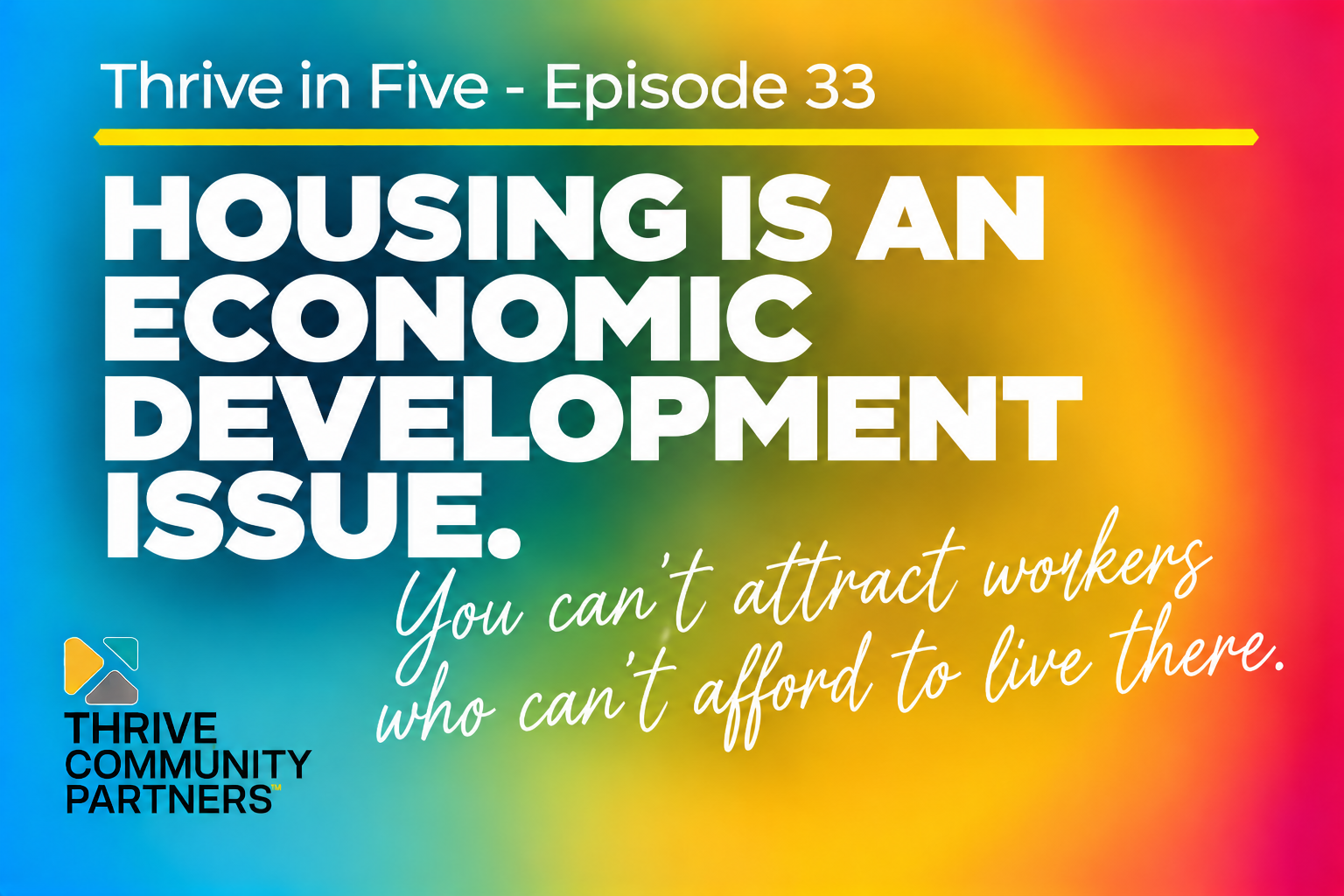
Sarah poses a question worth considering in Episode 33 of Thrive in Five:
If your economic development plan doesn't have a housing chapter, is it missing the piece that might determine whether everything else works?
That doesn't mean every economic development organization needs to become a housing developer.
Nor does it mean that every housing challenge can be solved through an economic development initiative.
It means recognizing that these issues are connected and planning accordingly.
Housing should be considered when evaluating workforce needs, pursuing business attraction opportunities and supporting the expansion of existing employers.
It should be part of the conversation about what a community needs to grow.
And it should be supported by partnerships that bring housing expertise and economic development priorities together.
Because a community's ability to attract investment depends, in part, on its ability to support the people who make that investment possible.
Stronger Communities Connect the Dots
Successful community development requires looking beyond individual projects and organizational responsibilities.
Housing affects workforce availability.
Workforce availability affects employers.
Employers influence economic opportunity.
And economic opportunity shapes the long-term health of a community.
These aren't isolated challenges.
They're interconnected parts of the same system.
Communities that recognize those relationships can make more informed decisions about where to focus their resources, which partnerships to build and how to prepare for future growth.
Housing and economic development aren't separate conversations. They're part of the same strategy.
Start the Conversation
At Thrive Community Partners, we help communities connect strategy, partnerships, funding and implementation to move meaningful initiatives forward.
Whether your community is navigating workforce challenges, planning for economic growth or identifying barriers to development, a coordinated approach can help turn competing priorities into shared solutions.
Ready to connect the dots in your community?
I'm Sarah with Thrive Community Partners. This article is based on an episode of Thrive in Five, where we share practical ideas for moving organizations and communities forward in five minutes or less.